
Rash Decision
Why You Should be Itching to Plant Poison Oak

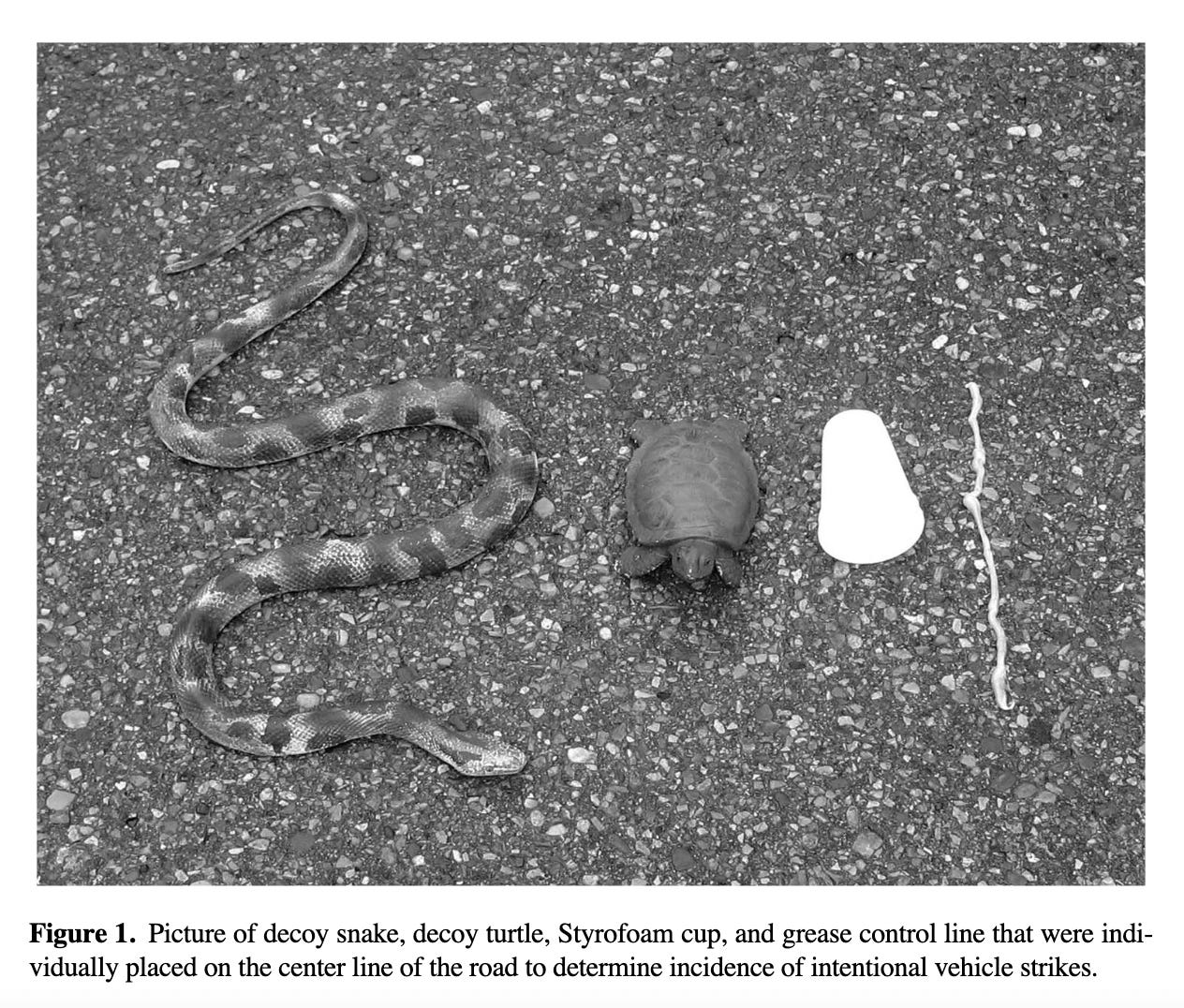
A 2007 study with the unintentionally hair-raising title, “Incidence of Intentional Vehicle-Reptile Collisions” examined — in the interest of local reptile species preservation — the supposition that people in the area were running over snakes crossing the road on purpose. In the study, a decoy rubber snake was placed on a road along with a faux turtle and, as a control, a Styrofoam cup. Guess which object drivers ran over the most? In fact, a significant number of drivers redirected their vehicles, even crossing the center line of the road, expressly to crush the hapless “snake” with their tires.
The conclusion of the study? Some people really don’t like snakes.
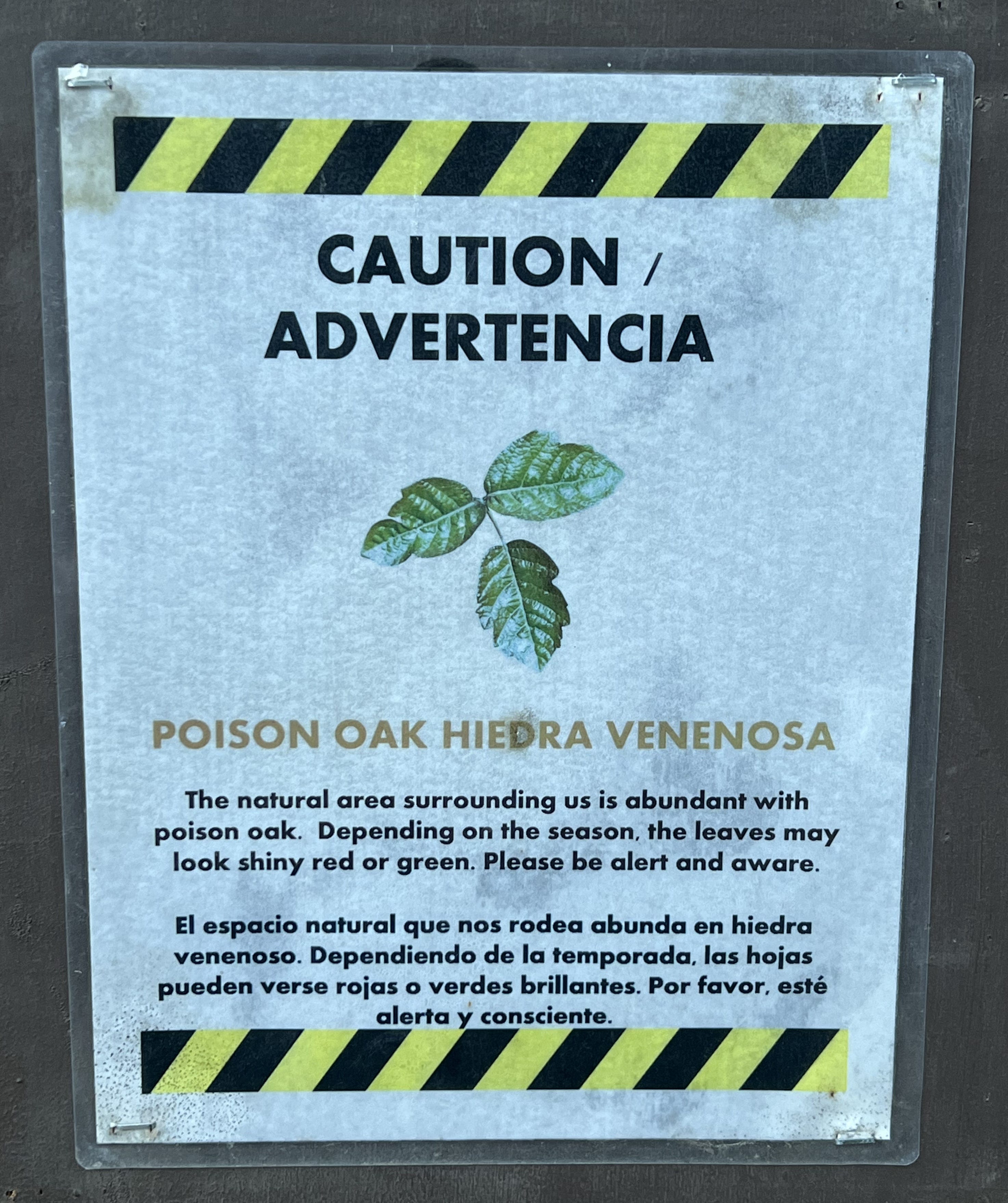
What, you might ask, does this murderous iteration of human ophidiphobia (fear of snakes) have to do with Poison Oak? Well, like snakes, some of which, as we know, happen to be venomous, Poison Oak, or Toxicodendron diversilobum, doesn’t exactly pass the “warm and fuzzy” test. Both have a habit of appearing suddenly, out of nowhere, with potentially unpleasant results. Hearing, close by, the threatening sound of the rattle belonging to an invisible Western Diamondback has its botanical equivalent in that awful moment when your hand, arm, shin or face brushes up against something on a hiking trail and you look back only to see those shiny, “Leaves of Three” nodding in your wake. While not exactly life-threatening, such an encounter with Poison Oak is, at the very least, a classic “Oh, Fuck” moment.
If, like me, you’re susceptible, Poison Oak’s resiny “poison,” called urushiol, goes to work instantly, as your skin’s contact with the leaves or stems of the plant trigger an allergic reaction. (In other words, the source of the rash is your body’s own immune system. Poison Oak is not, strictly speaking, poisonous.) This contact dermatitis can range from a minor irritation to a suppurating field of painful, fluid-filled blisters that can persist for weeks, appearing and popping open like little water balloons before they crust over and itch like hell.
While not for the faint of heart, this harrowing “Skin Rash Hall of Fame” features some truly horrific cases of Poison Oak and Ivy exposure. (Both are members of the toxicodendron genus.)
Adding insult to the injury, humans appear to be the only species for whom urushiol is an allergen. While munching on the leaves of Poison Oak could quite possibly kill you, a Mule Deer doing the same thing won’t even suffer from indigestion. In fact, she’ll find it a tasty and nutritious snack. Your dog, frolicking through a thicket of Poison Oak with no protection? No problem. You? Not so much.
All of which is to say, it isn’t difficult to understand why people might fear or even hate Poison Oak. Like the fear of snakes, it’s not by any means an entirely irrational response. So why, you might ask, have I actually planted this universally despised woody perennial in my own backyard?
Toxicodendron diversilobum, how do I love thee? Let me count the ways.
It’s beautiful
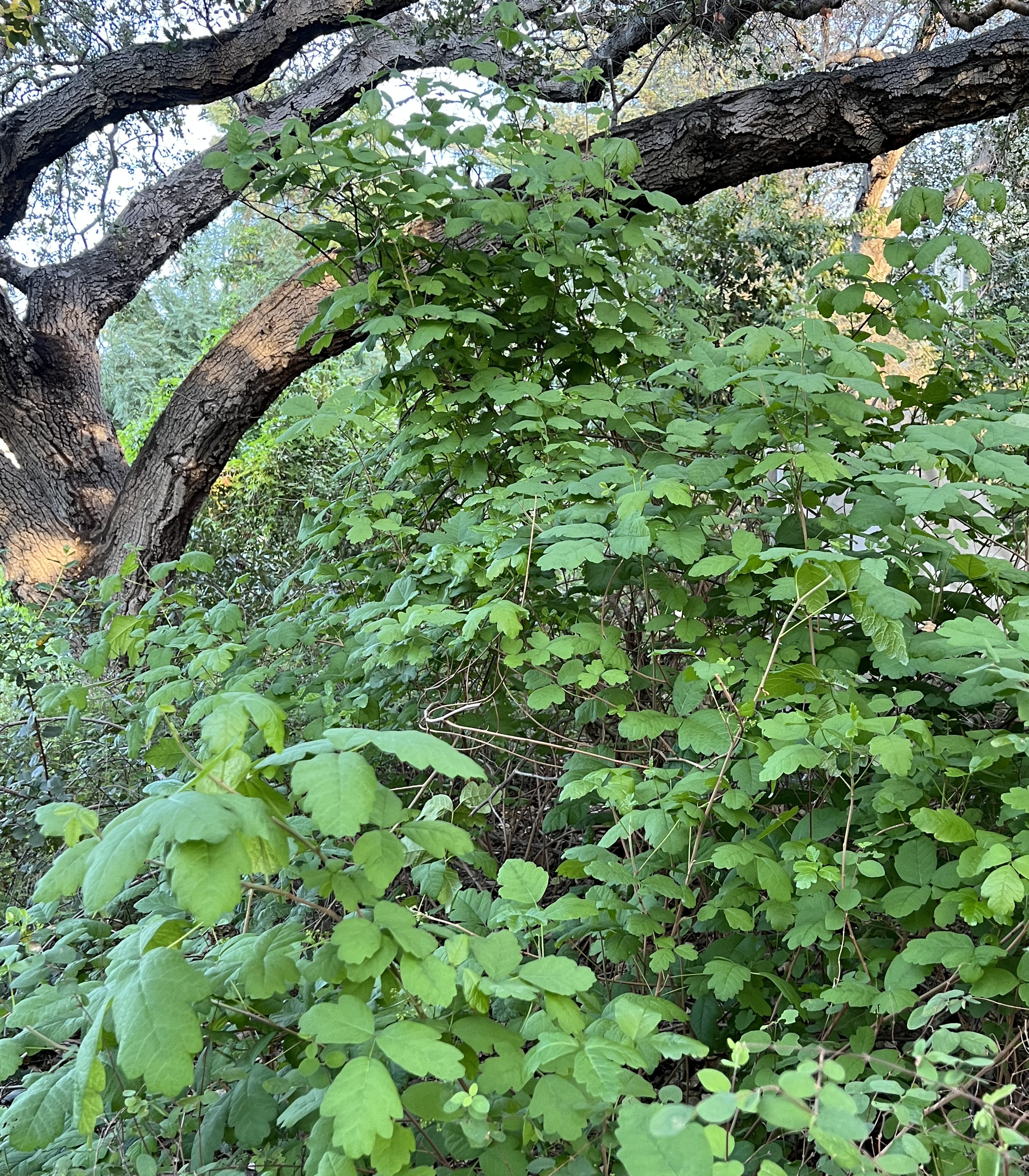
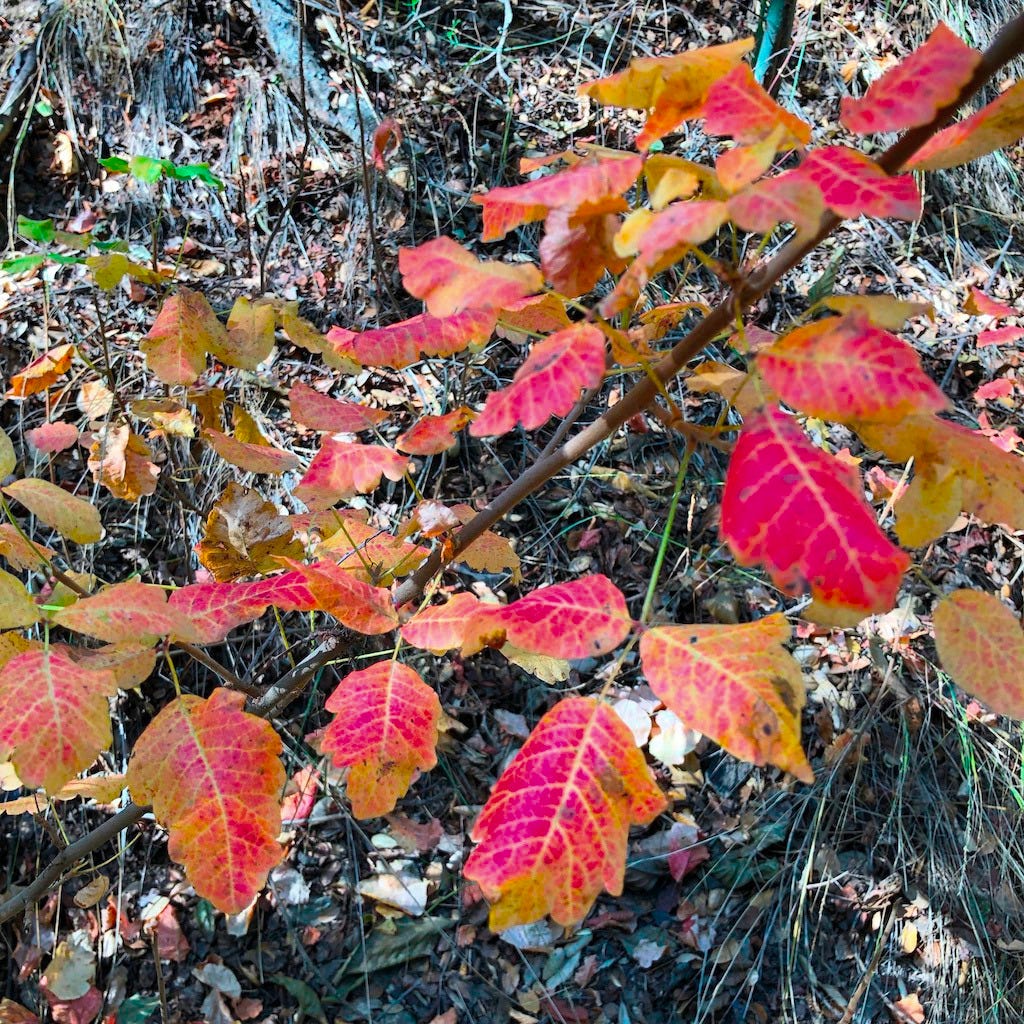
Having entwined itself within a tangled patch of Bitter Gooseberry (Ribes amarum) in my garden, Poison Oak displays a vivid green in mid-winter against the shriveled, brown leaves and bare, thorny branches of these summer-deciduous plants. The glistening surface of the elegantly shaped trio of leaflets reflects the dappled sunlight that penetrates the Coast Live Oak canopy under which it thrives without a drop of supplemental water. In the fall, the leaves start to turn various shades of pale yellow, orange and red before they drop, contributing some rare, “fall color” to our relatively neutral fall landscape.
It’s nutritious
Waxy Poison Oak berries—a creamy, off-white—ripen in the summer and are an important food source for a virtual Who’s Who of the avian world: Wrentits; Nuttall’s Woodpeckers; Spotted Towhees; the Oak Titmouse and a wide assortment of finches. As previously mentioned, Poison Oak’s leaves are foraged by deer and for good reason: they’re loaded with protein and minerals.
It belongs here
Now that it’s been largely extirpated from most urbanized areas of Los Angeles, I believe other remnant native species here – with whom Poison Oak co-evolved over eons – quite literally “miss” its presence. (This would include such survivors as Coast Live Oak (Quercus agrifolia) and Toyon (Heteromeles arbutifolia.) On my property, for instance, there has always been a single, indigenous patch of Poison Oak, suggesting that it was more locally widespread in the neighborhood before someone decided to build houses here a little over a century ago. (Fun Fact: A major Tongva village that once stood near City Hall in downtown Los Angeles was called Yangna, meaning “Place of the Poison Oak.”)
It appears to be true that removing exotic plants from under a mature oak canopy – especially weedy, European annual grasses – is one of the most effective things you can do to support the overall health of the tree. Likewise, selectively reintroducing native understory plants with whom your old oak was once familiar seems to have a similar effect and, in my experience, Poison Oak is perhaps the most therapeutic of all.
Why might that be? Individual plants’ root systems have been shown to communicate with one another through a network of subterranean soil fungi called Mycorrhizae (sometimes referred to as the “Wood Wide Web”). Plants familiar with one another can share resources among themselves through this fungal internet and can even warn each other of insect predators in the area. I like to imagine that our native oaks “recognize” Poison Oak when it is returned to its rightful place and react much as one might to seeing a dear old friend, one whose vital contributions have long been missing from an important conversation.
It’s badass
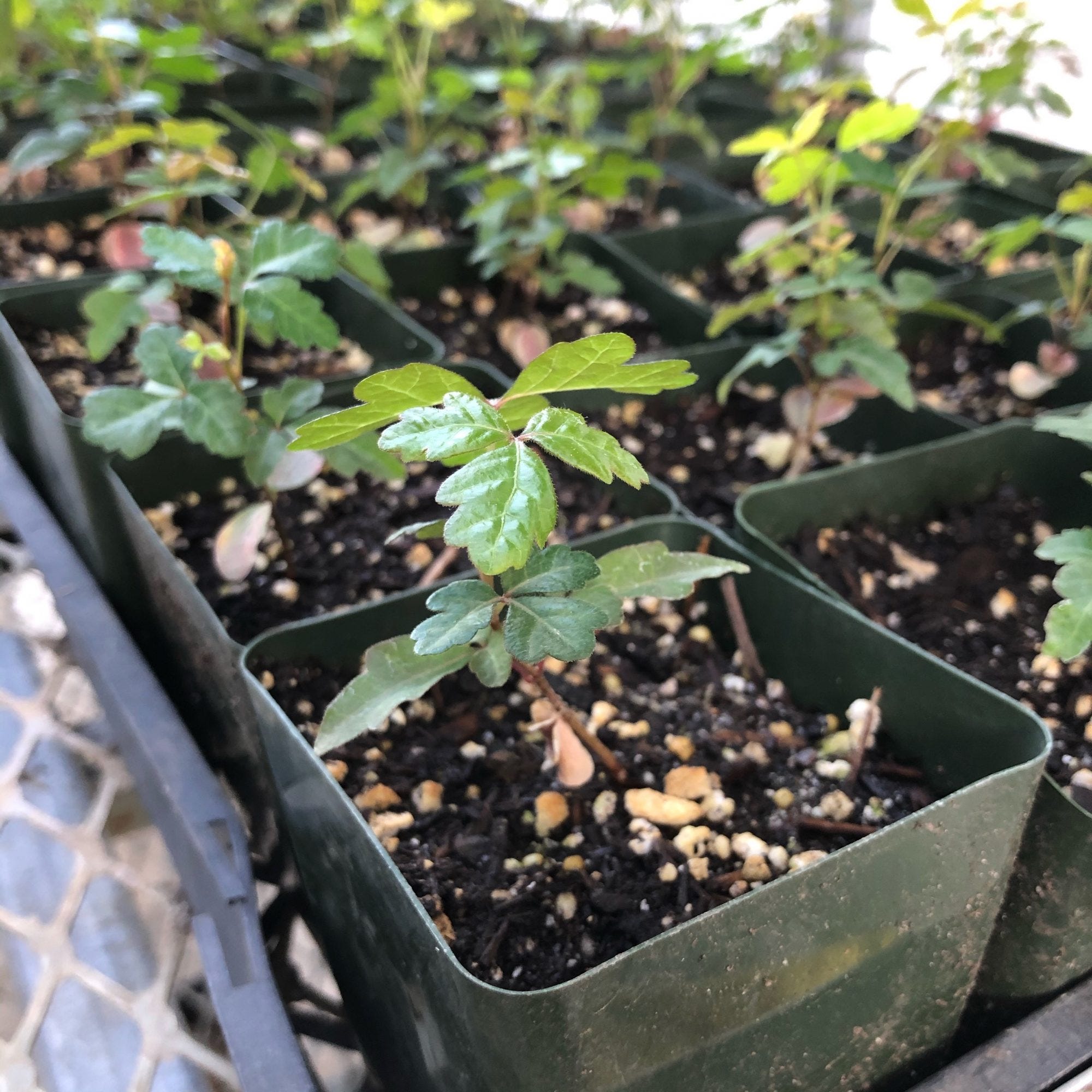
Frankly, planting Poison Oak in your own backyard is radical native gardening, and for those of you out there brave (or crazy) enough, LA Native Plant Source offers Poison Oak in one-gallon pots from time to time. While it’s admittedly a bit of a loss-leader for the nursery (I know, you’re shocked), it does serve to make a point: we really mean it when we say we’re serious about hyper-local habitat gardening for the benefit of wildlife.
It’s not always about us
Finally, aside from Poison Oak’s inherent beauty, importance to wildlife, rightful place in the biome and iconoclastic bona fides, giving this loathed, pariah a home in your backyard can be seen as a gesture of reparation for centuries of environmental pillage and devastation. It also represents a philosophical challenge to the ingrained habits of anthropocentrism – the view that human beings are the only arbiters of what is good, important or necessary in the world. (Anthropocentrist judgements are based solely on an extremely narrow evaluation of how the thing in question can either harm or benefit people, without any regard for how it might harm or benefit other forms of life with whom we share this planet.)
Case in point: several years ago, I was hiking along a canyon trail in the San Gabriel Mountains when, from the opposite direction, I saw a pair of hikers coming toward me. One was holding a leash and walking what looked, from a distance, like a goat. As they got closer, I saw that it actually was a goat. On a leash. In the Angeles National Forest.
You can’t make this shit up.
Anyway, we chatted briefly as we passed one another and, as diplomatically as I could I expressed my concern that the seeds of exotic species might be spread in the canyon through goat droppings, an example of which was unceremoniously deposited at my feet even as we spoke. (Imported European livestock animals were, after all, the vectors through which invasive exotic plants first gained a foothold in the formerly pristine ecosystems of California.) While I’m aware that they probably thought, with some justification, that I was just being an asshole, the goat’s owners seemed blithely unconcerned and cheerfully offered me their opinion that “on balance” their visiting pet goat did “more good than harm” to the environment of the canyon because – wait for it – “she eats Poison Oak.”
Oh, great. I’ll be sure to tell the Spotted Towhees. They’ll be thrilled.
Now if you’ll excuse me, I have to go run over a snake.
– Eric Ameria
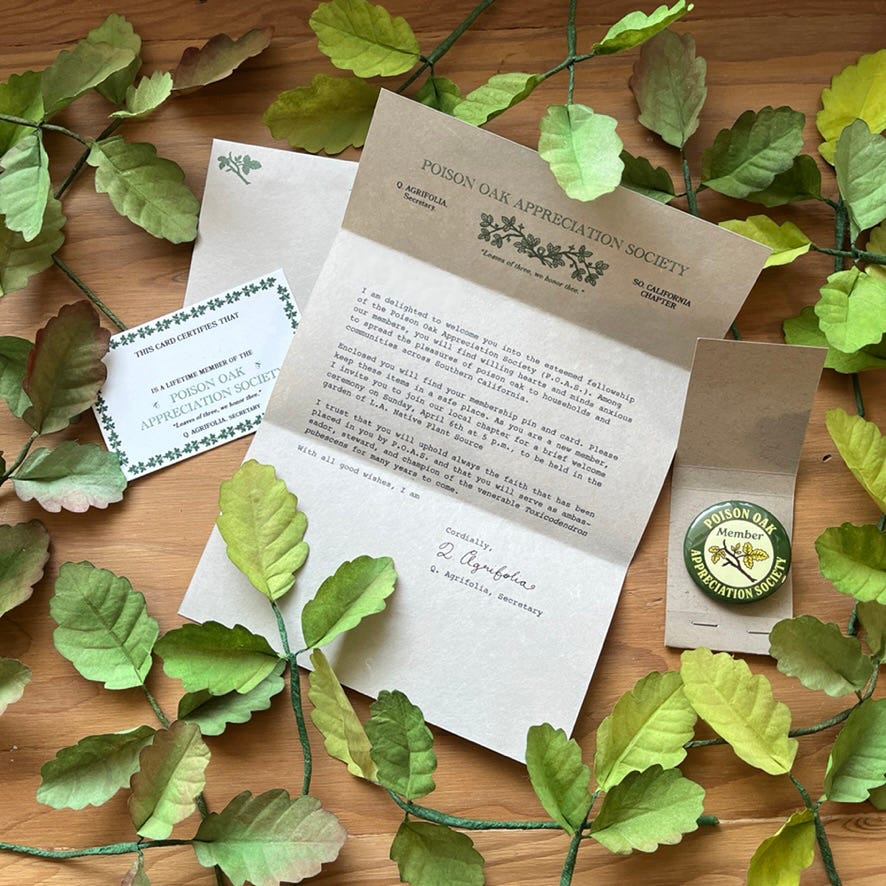
@Dune Gardens - I couldn’t agree more! This is Eric Ameria at his brilliant best, expounding on a topic near and dear to his heart. And I’m not just saying that out of giddiness over the shout out. POAS members, unite!
“Oh, fuck”